
Hustle Culture and Games
Disclaimer
This post is going to be a lot more personal and maybe a bit less polished than the typical one. While a lot of the issues I’ll be writing about in this do apply to the tech and programming world, this post isn’t really about anything directly related to tech or programming. Because of that, I was really contemplating whether or not to write about this subject, but remembered that one of the very first sentences in my About Me page was “this website, above all, is meant to be a way to help tell you who I really am!”. So, ironically, my posting only tech and programming stuff would’ve actually gone against the very principles I laid out for this Antholog. With that in mind, I hope you enjoy, and expect the occasional post to be a bit more personal.
The Power and Pain of Games and Gamification
As I’ve likely said an obnoxious amount of times in this Antholog already, games are amazing. They transform their audience from passive spectators to active participants. Games are empowering in that way, letting you do more than just listen to the stories, but to shape them and interact with them. Games can tell you who you are and inspire you. Above all, games are fun, and the good ones are proper art.
But, for all the waxing poetics I can say about games, there is, like all things, that dark underbelly. The word gamify, to apply the principles of games to work, life, and hobbies, seems to have started circulating around the early 2010s. In principle, this can sound exciting and engaging, especially to people like me who already love games.
Unlike most of life, games have visible statistics and objectives. Even in games that don’t show a lot of numbers, like Zelda, you have a certain number of hearts that can increase throughout your quest. Games offer definition in a lot of areas that life just doesn’t. Some games display health or ammo, others show your relationship status with your friends and family, and others tell you your strength and stamina.
When you then look at how often life is frighteningly ambiguous, that philosophy of gamifying suddenly sounds a lot more appealing. Your life and all your problems are measurable and conquerable. But, for all its luster, this mindset seems to also come up often in what we refer to as hustle culture. There’s even similar wording between this culture and gaming, like grinding or side-hustle/side-quest.
For those who somehow aren’t aware, hustle culture is essentially the newest term for a lifestyle where your main focus is work and metrics. It’s characterized by ideas/goals like waking up at 4:00 am, going to the gym for 2 hours every day, only taking cold showers, getting a 6-figure salary, working 12 hours a day, and forgoing social interactions and events unless career-oriented. It’s filled with both fictional and nonfictional role models such as Bruce Wayne, Patrick Bateman, David Goggins, Gordon Ramsay, most high-paid athletes, etc. As in, the people who are the strongest, fastest, richest, most famous, and successful.
It’s the mentality of high motivation, profound discipline, and going all in until your goals are met. You live to work, and the work itself is the reward, no matter how grueling or tiresome. Hence, hustle culture’s mantras of “no pain, no gain” and “rise-and-grind”. You wake up, you work, you sleep (optional), you get hurt, you take pride in the pain. You bleed, you smile, you endure, you beg for more.
To most sane people, this sounds highly unrealistic, robotic, and depressing. However, I was not most sane people and even now, as a recovering perfectionist/overachiever, this can definitely sound exactly like what you’re looking for. You finally decide to get your life together, and never stop. And unfortunately, it feels pretty amazing, at least for a while. In the beginning, you’re waking up early, you’re doing your workouts, you’re eating exactly what you should be, you’re working up to 14 hours a day sometimes, you’re finally… progressing, leveling up. You’ve got your metrics, and you’re hitting almost every single one of them.
No (All) Pain, No Gain!
When I first moved after graduating from college, I swore to myself that I would become all that I thought I was meant to be, that I’d get out of my depressive mindset, and start really achieving and showing what I could do. Little more than a month after moving, I came up with the ultimate schedule.
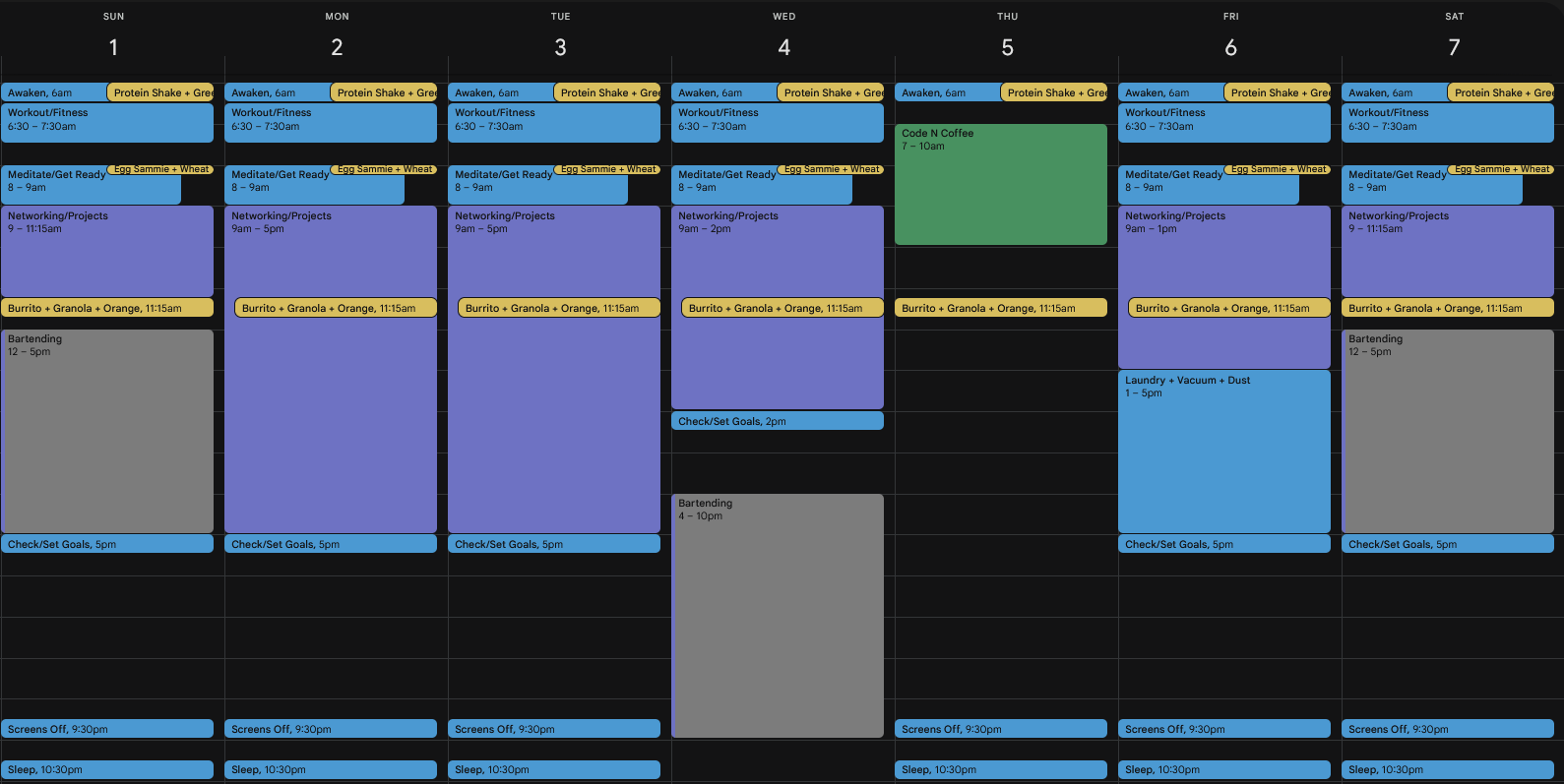
(may require opening in its own tab to see properly)
I was waking up at 6:00 am, working out, showering, and then immediately working on networking and projects for at least 8 hours. I had screens off at exact minutes, I was performing at work, and I was following routines to a tee. Sure, I was a bit tired, but I felt like a brand new man.
That brand new man lasted about two weeks.
I started slipping up on certain routines, life got hectic in unexpected ways, and I was lying in my bed with no caffeine or screens yet awake and with a racing mind for hours on end. In retrospect, the pressure of not being able to hit my metrics, the fear of missing a time-block or meal, and the anxiety of not getting enough sleep, it wore me down.
On top of that, it made me frustrated. As you get more tired, you start slipping up, and the more I did, the more frustrated with myself I got. It was little things, like maybe not waking up until 7 am, or not being able to focus on work despite only working a typical 9-5, or maybe missing a workout. Little things like that, compounded with the 6-7 hours of sleep I was getting, all resulted in some pretty bad burnout that I’m only recently getting over.
I wish I could say that I’m one of the only people I know who have had this kind of problem, but unfortunately, it seems very common amongst people my age. It’s especially common in the world of programmers and tech. That ‘grindset’ and ‘move it or lose it’ attitude can drive nearly every project. Less resources, less time, less humanity, just to see if we can still hit those metrics.
The Cost of ‘Perfection’
There’s a really great video I watched that talked about the lives of ancient Romans, and argued that they’d likely see current hustle culture and be disgusted rather than impressed. There are two excerpts in that video that really stuck out,
“Work is the main event, leisure is the break. Romans saw it the exact opposite way. Their word for the ideal state of life was Odium… time dedicated to the things that make you human. Reading, writing, philosophy, gardening, friendship, and contemplation. To a Roman of the upper class, this was your real job. This was the purpose of being alive.”
and
“They didn’t define leisure by the lack of work; they defined work by the lack of leisure. Work, or negotium, was the negative state; it was the annoying thing you had to do, the distraction that kept you from your actual life. “
To be brutally honest, it’s quotes like this that make me want to cry, because it makes me look back on the last 10+ years of my life, and remember how as early as 12 years old it became filled with phrases like “if I’m not perfect, or trying my best, I don’t think people would want to be my friend. I don’t think people would like me in their life,” and “Today you tried your best, it wasn’t enough, it’ll never be enough. That’s the beauty of it. Tomorrow, we try again, and maybe then we’ll be enough.”
Pretty depressing things to start saying to yourself at 12, but I didn’t know any better yet. I tried as hard as I could for so many years, with everything. Sure, I got accolades, great grades, good opportunities, and met some amazing people. But still, there was a cost, a sacrifice. If you only live to work, then you have to kind of give up on living. You have to give up on your humanity, at least a little bit. At least, with the way I was going about things, successes meant both everything and nothing, especially when I was always over-preparing for the next potential failure around the corner.
Especially now, looking back on college, I think about things I could’ve done, the people I would’ve let myself be happy around, if I didn’t start following that sort of hustle culture so early. I was so convinced that I had to work in order to live, that I couldn’t just ‘live’. My life was my job, my classes, my projects. I worked alone and had to mask in front of everyone. Just like in the games I so dearly loved, there were metrics, and if I wasn’t treating life like a game to master, then I wasn’t playing correctly.
There’s another quote that I love by NFL coach Bill Walsh, which reads
“The score takes care of itself.”
That’s true for both games and life. You forget to enjoy the game if you’re only focused on a high score. You forget to live life if you’re only focused on the metrics. The more you live your life chasing those high scores, the less of a ‘high’ you’ll probably get each time.
Now, at 23, it takes vastly more effort for me to relax than it does to not. It’s a vicious cycle, working as hard as I can for as long as I can, getting inevitably burnt out, resting without peace, then working as hard as I can again, then eventually looking back on what I could’ve done instead without sacrificing so much. Like Vader, you “become more machine now than man.”
So, what’s next?
Why am I spending so much time talking about this? Because that ‘perfect’ schedule I made was nice for a while, but the pain of seeing it slip away triggered a lot. It was a really painful but necessary reminder that we need to grow up, that perfection isn’t the way to live, that a schedule and life deserve to be more than just a checklist of never-ending items.
Fortunately, I’ve been grateful enough to get to connect with lots of wise family, friends, entrepreneurs, and self-starters. They’ve given great advice and, along with some excellent YouTube videos, I’ve taken away so far the following lessons:
- just write down 2-3 things you need to do each day
- move from a ‘i have to’ mindset to a ‘i get to’ mindset
- do processes, not goals
- check in with yourself each week, be honest
- take time for spiritual practice and community
- work off your own energy, recognize when your mind is most & least active
- have specific routines for your morning and night
The First Draft
As the first step towards really maturing my schedule, here’s the first draft of that new life:
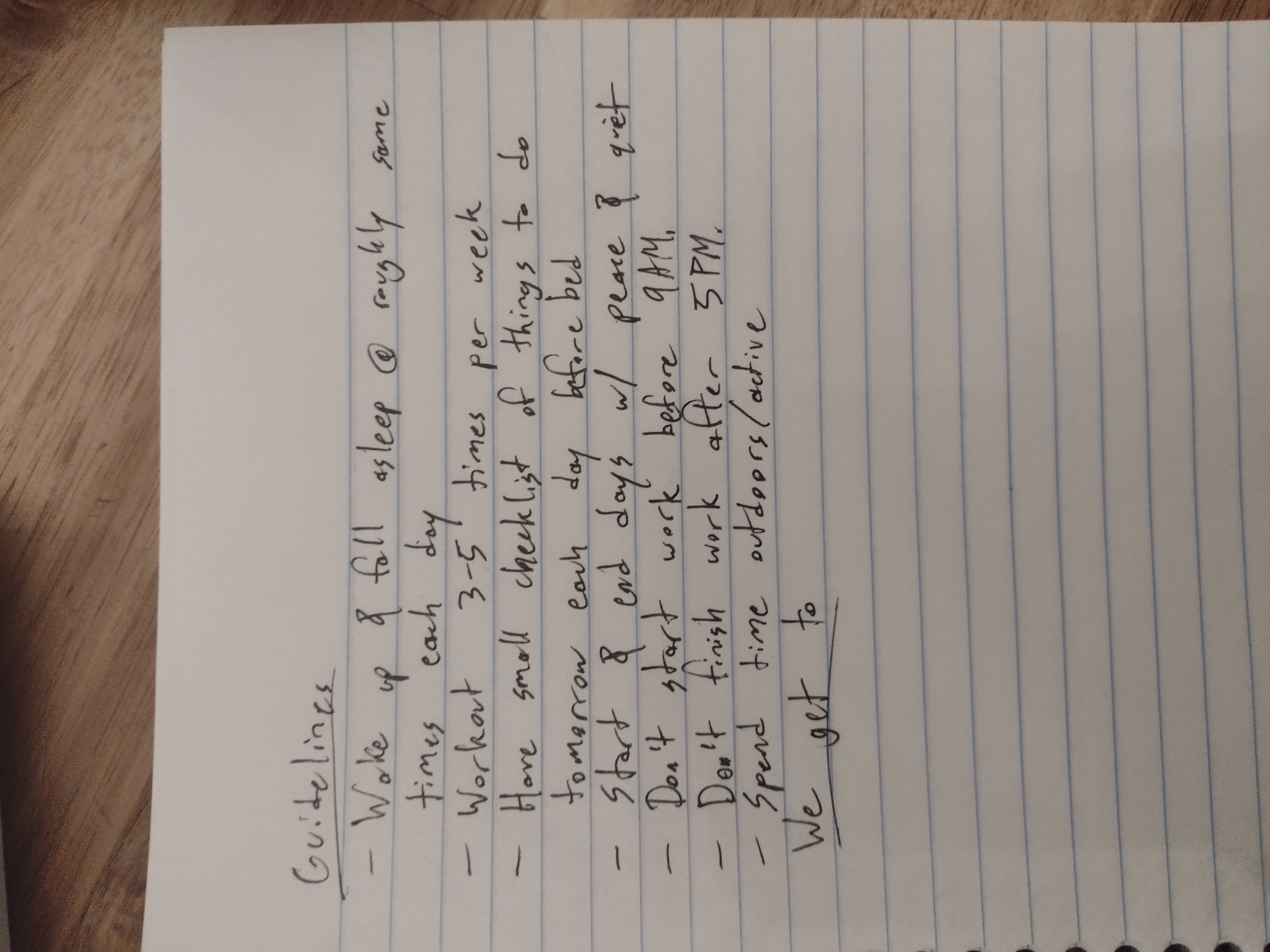
As you can see, we’ve got more ‘guidelines’ than anything. Hardly any time-blocks, just general rules to try and follow. Some are per-day, some are per-week. No more “work out at exactly 6:30 am every morning”, now it’s just “aim for at least 3 sessions per week.” What I love about this is that it gives me flexibility, so that if there’s hypothetically a kickboxing class at 6:30 pm, then I’ll be able to join without burning myself out! No more crazy strict routines, now it’s just “work on your checklist between 9-5, enjoy life.” It’s even got my new favorite mantra at the bottom,
We get to
Hell, I might even get that tattooed one day. I’ll still probably use my Google Calendar, but likely only for scheduled meetings and events, and nutrition timing. This new ‘schedule’ is bare-bones, unoptimized, and… human. It’ll take some getting used to, but it’s more than worth the risk. I’m also going to be checking in with myself every week to see how I actually feel, instead of just pushing forward.
To the future, to life uncaged by metrics, to games played without score, to the curious and nonsensical ways of our world!
“One of my wise teachers, Dr. William F. Orr, told me, ‘There is only one thing evil cannot stand, and that is forgiveness.’ “ Fred Rogers